
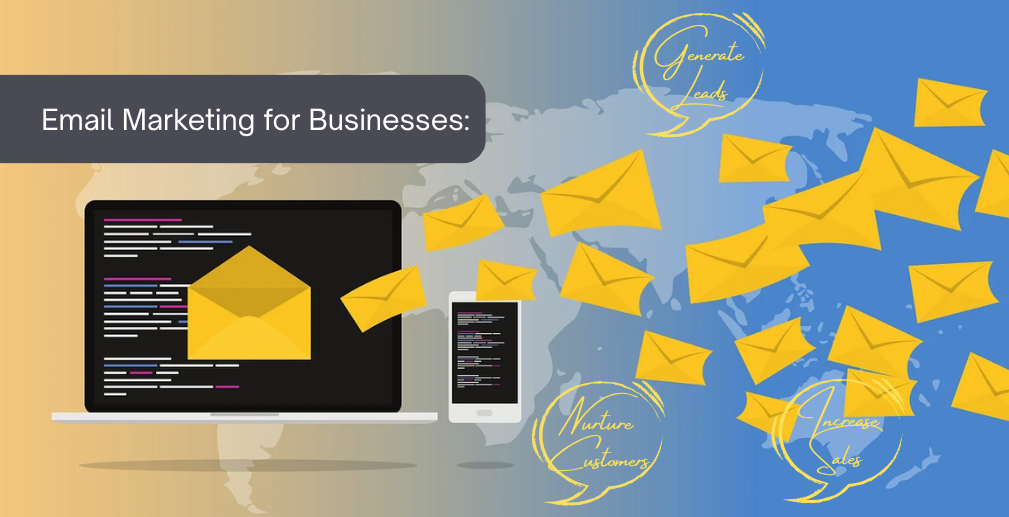
Email Marketing for Businesses: How to Generate Leads, Nurture Customers & Increase Sales
This is where email marketing for businesses can play an important role.
Email allows businesses to continue communicating with people who have chosen to receive their messages. With the right strategy, businesses can use email to generate leads, educate prospects, nurture relationships, encourage conversions, and stay connected with existing customers.
But effective email marketing isn’t simply about sending promotional emails.
It’s about delivering the right message to the right audience at the right stage of the customer journey.
In this guide, we’ll explore how businesses can build an email marketing strategy, generate leads, nurture prospects, use automation, measure performance, and turn email into a sustainable marketing channel.
What Is Email Marketing?
Email marketing is the use of email to communicate with subscribers, prospects, customers, and other audiences who have appropriately opted in to receive communications.
Businesses can use email to:
- Generate leads
- Nurture prospects
- Promote products and services
- Educate customers
- Share company updates
- Announce new products
- Invite people to events
- Increase repeat purchases
- Build customer relationships
- Re-engage inactive subscribers
Common types of email marketing include newsletters, promotional campaigns, welcome emails, lead-nurturing sequences, product announcements, educational campaigns, and automated customer journeys.
The most effective approach depends on your audience, business model, customer journey, and objectives.
Why Is Email Marketing Important for Businesses?
Email remains useful because it gives businesses a direct way to communicate with people who have chosen to hear from them.
Unlike relying entirely on social media algorithms or paid advertising, an email list can become an important owned marketing channel.
Here are some of the main benefits.
1. Generate and Nurture Leads
Many potential customers aren’t ready to purchase the first time they discover your business.
Email gives you a way to continue providing useful information while they evaluate their options.
For example:
Website visitor → Downloads guide → Joins email list → Receives educational content → Learns about your service → Requests consultation
2. Build Customer Relationships
People don’t always buy from a business immediately.
Consistent and useful communication can help your business stay connected with prospects and customers over time.
The key is to provide value rather than sending constant promotional messages.
3. Automate Repetitive Communication
Email automation can handle many routine communications.
For example:
New subscriber → Welcome email
Lead magnet download → Educational sequence
Customer purchase → Follow-up email
Inactive subscriber → Re-engagement campaign
This can reduce repetitive manual work and create more consistent customer communication.
4. Personalize Communication
You don’t have to send the same message to every subscriber.
You can segment audiences based on factors such as:
- Industry
- Location
- Service interest
- Purchase history
- Customer type
- Engagement
- Lead source
- Customer life cycle stage
This allows businesses to make their emails more relevant.
5. Measure Performance
Email campaigns can be measured using metrics such as:
- Delivery rate
- Click-through rate
- Conversion rate
- Unsubscribe rate
- Engagement
- Leads generated
- Sales or revenue where attribution is available
This allows marketers to identify what is working and what needs improvement.
How Does Email Marketing Generate Leads?
One of the most useful applications of email marketing is lead generation.
A simple lead-generation funnel looks like this:
Website Traffic → Lead Magnet → Opt-In → Email Sequence → Nurturing → Conversion
Let’s break it down.
Step 1: Attract the Right Visitors
Your website can attract potential customers through:
- SEO
- Google Ads
- Social media
- Content marketing
- Referral traffic
- Events
- Industry communities
- Other digital marketing channels
The goal isn’t simply to generate traffic.
You want to attract people who could realistically become customers.
Step 2: Offer Something Valuable
Give visitors a reason to subscribe.
This could be:
- Checklist
- Guide
- Template
- Report
- Free audit
- Webinar
- Industry research
- Consultation
- Educational resource
For example, a digital marketing consultant could offer:
“Free SEO Audit Checklist for Small Businesses.”
A visitor interested in SEO can download the resource in exchange for providing their email address and appropriate consent.
Step 3: Capture the Lead
Use a clear sign up form.
A basic form might request:
- Name
- Email address
- Optional business information
Don’t ask for unnecessary information.
The simpler the form, the easier it is for users to complete.
Make sure your sign up process clearly explains what the person is subscribing to and follows applicable privacy and email-marketing requirements.
How to Build an Email List
A successful email strategy begins with a quality subscriber list.
However, a large list isn’t necessarily a valuable list.
A smaller list of relevant, engaged subscribers can be more useful than thousands of people who never wanted your emails.
Effective Ways to Build an Email List
Website Signup Forms
Add relevant forms to pages where visitors are likely to be interested in your content or offer.
Lead Magnets
Offer useful resources in exchange for an appropriate opt-in.
Webinars
Invite people to register for educational sessions.
Free Consultations
Professional service businesses can use consultation requests as part of their lead-generation process where appropriate.
Content Marketing
Encourage readers to subscribe for future educational content.
Events
Collect appropriate email permissions from event attendees.
Avoid Buying Email Lists
Buying email lists may seem like a shortcut, but it can create significant problems.
Purchased lists can contain:
- Irrelevant contacts
- Invalid addresses
- Spam traps
- People who never requested your communication
This can damage deliverability and customer trust and may create compliance issues.
Build your list through legitimate, permission-based methods instead.
Lead Magnets That Can Grow Your Email List
Different audiences respond to different types of resources.
For B2B Businesses
Consider:
- Industry reports
- Checklists
- Case studies
- Templates
- Strategy guides
- Research reports
- Calculators
For E-commerce Businesses
Potential resources include:
- Buying guides
- Product guides
- Discounts where appropriate
- Early access
- Product recommendations
For Professional Services
Examples include:
- Free audit
- Consultation
- Checklist
- Assessment
- Educational guide
- Planning template
Your lead magnet should solve a problem that is relevant to the service you eventually want to sell.
Email List Segmentation
Imagine you have 5,000 subscribers.
Would every person have exactly the same needs?
Probably not.
That’s why segmentation can make email marketing more relevant.
You could segment subscribers based on:
- Industry
- Location
- Service interest
- Customer status
- Purchase history
- Lead source
- Engagement
- Website activity
- Customer life cycle stage
For example, a marketing consultant could create segments for:
SEO Leads
Google Ads Leads
Social Media Leads
Existing Clients
Newsletter Subscribers
Each group can receive content that is more closely related to its interests.
Email Personalization: More Than “Hi John”
Personalization is often associated with adding a subscriber’s first name.
But effective personalization can go much further.
Instead of simply saying:
Hi John,
you can personalize content based on:
- Industry
- Business type
- Previous interaction
- Content downloaded
- Product purchased
- Service interest
- Location
- Customer stage
For example, someone who downloaded an SEO checklist may receive SEO-related educational content rather than an unrelated social media campaign.
The objective is not personalization for its own sake.
The objective is relevance.
Types of Email Marketing Campaigns
Businesses can use different types of campaigns depending on their objectives.
1. Welcome Emails
A welcome email introduces your business and confirms what the subscriber can expect.
It can:
- Thank the subscriber
- Deliver a requested resource
- Introduce your business
- Set expectations
- Direct the subscriber to useful content
2. Email Newsletters
Newsletters can include:
- Educational articles
- Industry updates
- Tips
- Company news
- Product updates
- Resources
A good newsletter should provide enough value that subscribers want to continue receiving it.
3. Promotional Emails
Promotional campaigns can be used to communicate:
- Offers
- Products
- Services
- Events
- New launches
- Limited-time promotions where appropriate
Promotional emails should still be relevant to the audience.
4. Educational Emails
Educational emails help subscribers understand a problem, opportunity, process, or solution.
For example:
“5 Common SEO Problems Preventing Your Website From Getting Organic Traffic”
The email can educate the reader and then direct them toward a relevant service or resource.
5. Lead-Nurturing Campaigns
Lead nurturing involves providing useful information to prospects over time.
A sequence might include:
Problem → Education → Proof → Solution → CTAS
6. Re-Engagement Campaigns
Some subscribers become inactive.
A re-engagement campaign can attempt to reconnect with them.
For example:
“Still interested in digital marketing tips?”
You can give subscribers an opportunity to confirm whether they still want to receive your communications.
7. Customer Retention Emails
Existing customers can receive:
- Helpful resources
- Product updates
- New services
- Loyalty communication
- Educational content
- Follow-up messages
Retention communication should be useful rather than purely promotional.
How to Create a Lead-Nurturing Email Sequence
A lead-nurturing sequence is a series of emails designed to move a prospect through the customer journey.
Here’s a simple six-email framework.
Email 1: Welcome
Thank the subscriber and deliver the resource they requested.
Goal: Build a positive first interaction.
Email 2: Identify the Problem
Explain a common challenge your audience faces.
Goal: Help the prospect recognize the problem.
Email 3: Educate
Provide useful information about potential solutions.
Goal: Build understanding and trust.
Email 4: Provide Proof
Share:
- Case study
- Customer experience
- Results
- Example
- Relevant evidence
Goal: Demonstrate how the solution can work in practice.
Email 5: Present Your Solution
Explain how your product or service addresses the problem.
Goal: Connect the problem with your offering.
Email 6: Call to Action
Invite the subscriber to take the next step.
Examples:
- Book a consultation
- Request a quote
- Schedule a demo
- Purchase
- Contact your team
Email Marketing Automation
Automation allows businesses to send specific communications based on predefined triggers.
For example:
New Subscriber
Trigger: Signup
Action: Welcome sequence
Lead Magnet
Trigger: Downloads resource
Action: Educational sequence
Product Purchase
Trigger: Purchase
Action: Customer onboarding
Inactive Subscriber
Trigger: No engagement for a defined period
Action: Re-engagement campaign
Consultation Request
Trigger: Form submission
Action: Confirmation and relevant follow-up
Automation can make your communication more consistent while reducing repetitive manual tasks.
However, automated emails should still be reviewed regularly to make sure they remain accurate and relevant.
How to Write Effective Marketing Emails
A good marketing email doesn’t need to be complicated.
Focus on five key elements.
1. Subject Line
The subject line should make the purpose of the email clear.
Instead of:
Important Update!!!
Try:
5 Ways to Improve Your Local SEO
2. Opening
Get to the point quickly.
The reader should understand why the email is relevant.
3. Value
Give the reader something useful.
This could be:
- Information
- Insight
- Resource
- Offer
- Solution
- Educational content
4. Clear Message
Avoid trying to communicate five unrelated ideas in one email.
Focus on one primary message.
5. Call to Action
Make the next step obvious.
Examples:
Book a Consultation
Download the Guide
Request a Quote
Learn More
Schedule a Demo
Email Marketing for B2B Businesses
B2B buying decisions can take time.
A prospect may need to:
- Research providers
- Compare solutions
- Discuss internally
- Review pricing
- Get approval
- Speak with sales
Email marketing can support this longer journey.
A B2B email strategy might include:
Awareness → Education → Evaluation → Sales Conversation → Conversion → Retention
Useful B2B email content can include:
- Industry insights
- Case studies
- Research
- Educational guides
- Product information
- Webinars
- Events
- Customer stories
Email Marketing for B2C Businesses
B2C businesses may use email for:
- Product announcements
- Promotions
- Seasonal campaigns
- New arrivals
- Product recommendations
- Customer retention
- Re-engagement
- Post-purchase communication
For e-commerce businesses, email can become an important part of the customer life cycle.
Email Marketing for Local Businesses
Email marketing isn’t only for large companies.
Local businesses can use it to maintain relationships with customers and prospects.
Examples include:
Healthcare
- Educational information
- Appointment-related communication
- New services
- Practice updates
Restaurants
- New menu announcements
- Events
- Seasonal offers
- Customer loyalty communication
Consultants
- Industry insights
- Guides
- Webinars
- Consultation offers
Home Services
- Seasonal maintenance information
- Service reminders
- Educational content
- Offers
Always make sure communications are appropriate for the business and comply with applicable regulations, particularly in sensitive industries such as healthcare.
Email Marketing Metrics You Should Track
Sending emails isn’t enough.
You need to understand how your campaigns perform.
Delivery Rate
Measures how successfully emails are delivered.
Open Rate
Shows how many recipients opened an email according to your email platform’s tracking methodology.
However, open rates are not perfectly reliable because privacy features and technical limitations can affect open tracking.
Therefore, don’t evaluate campaign success using open rates alone.
Click-Through Rate
Measures the proportion of recipients who clicked links in your email.
Conversion Rate
Measures how many recipients completed the desired action.
For example:
Email → Website → Consultation Form → Lead
Unsubscribe Rate
Shows how many subscribers opted out.
A rising unsubscribe rate can indicate issues with:
- Content relevance
- Frequency
- Expectations
- Audience targeting
Leads and Revenue
Where reliable attribution is available, connect campaigns to business outcomes.
Ultimately, businesses should care about more than opens and clicks.
They should ask:
Did this campaign generate meaningful business results?
How to Measure Email Marketing ROI
A simplified ROI formula is:
ROI = (Revenue Attributed to Email − Email Marketing Costs) ÷ Email Marketing Costs × 100
Email marketing costs can include:
- Software
- Strategy
- Copywriting
- Design
- Management
- Automation
- Analytics
Attribution isn’t always straightforward, so businesses should establish a consistent measurement approach rather than assuming every conversion came entirely from one email.
Common Email Marketing Mistakes
1. Buying Email Lists
Build your audience through permission-based methods.
2. Sending Too Many Emails
More emails don’t automatically mean better results.
3. Sending Irrelevant Content
Segment your audience where useful.
4. Weak Subject Lines
Make the value or purpose understandable.
5. No Clear CTAS
Tell the reader what to do next.
6. Ignoring Mobile Users
Make emails easy to read and interact with on smaller screens.
7. Never Testing
Test relevant elements such as subject lines, content, CTAs, and landing pages.
8. Ignoring Unsubscribe Requests
Respect subscriber preferences and applicable requirements.
9. Poor List Hygiene
Maintain your subscriber database and follow your email platform’s policies.
10. Focusing Only on Open Rates
Look at clicks, conversions, leads, sales, and other meaningful business outcomes.
Email Marketing Automation vs Manual Campaigns
Both approaches have a place in a strong email strategy.
| Manual Campaigns | Automated Campaigns |
|---|---|
| Sent at planned times | Triggered by defined actions |
| Useful for announcements | Useful for ongoing customer journeys |
| Requires regular preparation | Reduces repetitive communication |
| Newsletters | Welcome sequences |
| Promotional campaigns | Lead-nurturing sequences |
| Product launches | Customer onboarding |
A business can combine both.
For example:
Automated: Welcome sequence
Manual: Monthly newsletter
Automated: Lead-nurturing sequence
Manual: New service announcement
How Often Should Businesses Send Emails?
There is no universal frequency that works for every business.
The right frequency depends on:
- Audience
- Industry
- Business model
- Content quality
- Customer expectations
- Sales cycle
- Subscriber preferences
The most important principle is:
Set expectations and provide value.
If subscribers signed up for a weekly newsletter, don’t suddenly send several promotional emails every day without a good reason.
Email Marketing Tools and Technology
A complete email marketing system may include:
Email Marketing Platform
For sending and managing campaigns.
CRM
For managing customer and lead information.
Lead Capture Forms
For collecting appropriate subscriber information.
Marketing Automation
For creating triggered customer journeys.
Analytics
For measuring campaign performance.
Landing Pages
For converting visitors into subscribers or leads.
Segmentation
For delivering more relevant communications.
The right technology depends on the size, complexity, budget, and requirements of your business.
Email Marketing Compliance and Privacy
Email marketing should always be permission-based and responsible.
Businesses should consider:
- How subscribers provide consent
- What they are agreeing to receive
- How their information is stored
- How they can unsubscribe
- How opt-outs are handled
- Whether communications are clearly identified
- Applicable privacy requirements
- Applicable email marketing laws
Requirements vary by country and audience.
If you operate internationally, make sure your processes account for the rules that apply to your recipients and business.
How to Build an Email Marketing Strategy
A practical strategy can follow these steps.
Step 1: Define Your Objective
Do you want to:
- Generate leads?
- Increase sales?
- Nurture prospects?
- Retain customers?
- Promote a service?
- Increase repeat purchases?
Step 2: Define Your Audience
Understand:
- Who they are
- What they need
- What problems they have
- What they are interested in
- Where they are in the buying journey
Step 3: Create an Opt-In Strategy
Decide how you’ll attract subscribers.
Examples:
- Lead magnet
- Newsletter
- Webinar
- Consultation
- Resource download
Step 4: Segment Your Audience
Create useful groups based on relevant information.
Step 5: Develop Your Content
Plan:
- Welcome emails
- Educational emails
- Promotional campaigns
- Newsletters
- Lead-nurturing sequences
- Customer emails
Step 6: Build Automation
Identify repetitive communication that can be triggered automatically.
Step 7: Create Landing Pages and CTAs
Make it easy for subscribers to take the desired next step.
Step 8: Launch
Start with a manageable campaign rather than trying to build everything at once.
Step 9: Measure
Track:
- Clicks
- Conversions
- Leads
- Sales
- Unsubscribes
- Engagement
Step 10: Optimize
Use your data to improve:
- Subject lines
- Content
- Segmentation
- CTAs
- Landing pages
- Timing
- Automation
Email Marketing Strategy Example
Let’s take a digital marketing consultant as an example.
Step 1: Lead Magnet
Free SEO Audit Checklist
↓
Step 2: Website Opt-In
A visitor downloads the checklist and provides an appropriate email opt-in.
↓
Step 3: Welcome Email
The checklist is delivered.
↓
Step 4: Educational Email
Explain common SEO problems businesses experience.
↓
Step 5: Case Study
Show how a business improved its online visibility after addressing SEO issues.
↓
Step 6: Service Email
Explain your SEO services and approach.
↓
Step 7: CTAS
Book a Consultation
This is a simple example of how email can move a person from initial interest toward a potential sales conversation.
When Should You Hire an Email Marketing Consultant?
You may benefit from professional email marketing support if:
- You have leads but aren’t following up consistently.
- Your campaigns aren’t generating meaningful engagement.
- You don’t have an email strategy.
- You need automated lead nurturing.
- You don’t have the time to manage campaigns.
- You need audience segmentation.
- You want to improve personalization.
- You need campaign reporting.
- You want email to work alongside SEO, paid advertising, content marketing, and social media.
A consultant can help identify opportunities, develop the strategy, create campaigns, build automation, and measure performance.
Email Marketing Services for Businesses
I provide email marketing support designed around your business goals and customer journey.
Email Marketing Strategy
Develop a practical strategy based on your audience, objectives, customer journey, and sales process.
Email Campaign Management
Plan, create, schedule, and manage relevant email campaigns.
Lead-Nurturing Campaigns
Develop sequences that educate prospects and guide them toward the next stage of the buying journey.
Email Automation
Build automated workflows for subscribers, leads, customers, and other appropriate audiences.
Email Copywriting
Create clear email copy, subject lines, messaging, and calls to action.
Audience Segmentation
Organize subscribers into relevant segments to improve communication relevance.
Campaign Optimization
Review campaign performance and identify opportunities for improvement.
Reporting & Analytics
Track meaningful metrics and connect campaigns with business objectives where measurable.
Frequently Asked Questions
What is email marketing for businesses?
Email marketing is the use of email to communicate with subscribers, prospects, and customers who have appropriately opted in to receive communications. Businesses use it for lead generation, education, nurturing, promotions, customer retention, and other marketing objectives.
How does email marketing generate leads?
Businesses can generate email leads by offering valuable resources, newsletters, consultations, webinars, or other relevant incentives through permission-based sign up forms. Those leads can then be nurtured with useful and relevant email content.
How can email marketing increase sales?
Email can support sales by educating prospects, promoting relevant products or services, nurturing leads, encouraging repeat purchases, and guiding subscribers toward specific actions. Results depend on factors such as audience, offer, timing, content, and the overall customer journey.
What is email lead nurturing?
Email lead nurturing is the process of communicating with prospects over time using relevant content and messages designed to help them move through the buying journey.
How often should a business send marketing emails?
There is no universal frequency. It depends on your audience, industry, content, business model, and subscriber expectations. Focus on consistent, relevant communication rather than simply increasing email volume.
What is email marketing automation?
Email marketing automation uses predefined triggers and workflows to send relevant emails based on actions or conditions, such as subscribing, downloading a resource, making a purchase, or becoming inactive.
How do I build an email subscriber list?
Use permission-based methods such as website sign up forms, newsletters, lead magnets, webinars, consultations, events, and other relevant offers. Avoid buying or scraping email lists.
What is the difference between email marketing and email automation?
Email marketing includes the broader strategy and campaigns used to communicate with subscribers. Email automation is a specific capability that uses triggers and workflows to send messages automatically.
How much does email marketing cost?
Costs depend on factors such as the size of your audience, email platform, campaign frequency, automation requirements, content creation, design, strategy, and management.
Should small businesses use email marketing?
Email marketing can be useful for small businesses when they have an appropriate audience, a clear value proposition, permission to communicate, and a strategy for delivering relevant content.
How do I choose an email marketing consultant?
Look for someone who understands strategy, lead generation, copywriting, segmentation, automation, analytics, and your specific customer journey. Ask about their approach, experience, reporting process, and how they measure business outcomes.
Is email marketing still effective in 2026?
Email remains a widely used business communication and marketing channel. Its effectiveness depends on factors such as audience quality, relevance, consent, content, deliverability, offer, timing, and the overall marketing strategy.
Conclusion: Turn Your Email List Into a Business Growth Channel
Email marketing isn’t about sending as many emails as possible.
It’s about building meaningful communication with people who have chosen to hear from your business.
A strong email marketing strategy can help you:
Generate leads → Educate prospects → Nurture relationships → Encourage conversions → Retain customers
Start with a clear objective.
Build a quality, permission-based subscriber list.
Segment your audience.
Create useful content.
Use automation where it makes sense.
Measure meaningful outcomes.
Then continuously improve your strategy based on data and customer feedback.
When email works together with SEO, paid advertising, content marketing, social media, landing pages, and conversion optimization, it can become an important part of a broader digital marketing strategy.
Ready to Build an Email Marketing Strategy for Your Business?
If you need help generating leads, nurturing prospects, creating campaigns, or setting up email automation, I can help you develop a practical email marketing strategy tailored to your business.
Email Marketing for Businesses
Plan smarter. Nurture better. Convert more effectively.